


Dear Readers,
Recently, I held a retreat for a group of men that opened my eyes in a way I had never experienced before. I could see each of them—from Israel, Venezuela, Peru, Morocco—not simply as individuals but as noble patriarchs, each entrusted with carrying their tribe forward as stewards of their culture.
I had never seen men in this way before, and I walked them through a meditation on the holy act of stewarding a tribe and the sacred communion of peace between tribes—a peacemaking meditation that is still reverberating in my heart.
This meditation stayed with me as I traveled through India these past weeks.
I am writing to you from the gardens of Suryagarh, in Jaisalmer, where I have been touched deeply and moved to share what this place has been quietly teaching me. Over these days, inviting in the new year with my family, I kept trying to understand what makes this place feel so profoundly different.
Delhi, as I wrote before, was a disheartening experience after having loved all of my prior travels through India. Delhi felt like a place that has lost something precious, and I wondered if all of India was losing something essential as modernity hurtles through with its voracious hunger to consume everything in its path.
Coming here renewed my faith in humanity—specifically, in witnessing that there is a man devoting his life to preserving what India has always been and what it can continue to be: an ark of culture worthy of preservation.
I had never thought much about Noah’s ark, but as I explored Suryagarh I could not help but feel the parallel between that ancient image and what has been built here.
The story of Noah’s ark is a symbolic map of inner transformation—a passage from corruption and chaos into purification, protection, and a new beginning with the Divine. It points to a clear discernment of what is out of alignment and the building of a safe inner ark of presence, a rebirth into a more conscious way of living. Noah was instructed to build an ark and bring his family and pairs of animals into it.
There is a parallel story told in the Vedas, the ancient spiritual scriptures of India. In that telling, Manu, the progenitor of humanity, saves a small fish who asks for protection. The fish grows vast and reveals itself as Matsya, the fish incarnation of Vishnu. Matsya warns Manu of a coming deluge that will destroy the world and instructs him to build a boat. Manu is told to gather pairs of animals—but also, and more importantly, to bring the Vedas themselves: all sacred knowledge must be carried into the ark.
Noah preserved biological diversity. Manu preserved the animals but also consciousness technologies—the Vedic transmissions of truth.
Both stories offer a teaching for our time: that we are human—entrusted with carrying forward what it means to belong to the tribe of humans, embodied, biological, and limited—and also beings capable of awakening to deeper spiritual knowing and the vastness of consciousness.
Human. Being.
For at least 4,000 years, across multiple civilizations, humans have understood that preservation in the face of destruction is a sacred duty. The story keeps returning because the crisis keeps returning, just in different forms. In ancient times, there were literal floods. Today, the flood is one of homogenization.
There is also a third version, told in the Quran. Prophet Nuh is said to have spent 950 years warning his people while building his ark as they mocked him. When the waters came, even his own son refused to board, believing he could survive on the mountain alone. He drowned. And God said to Nuh: “He is not of your family; he is one whose work was other than righteous.” Faith and community, this story teaches, transcend blood.
Judaism says: Save the covenant with creation—all life is sacred.
Islam says: Save the community of conscious believers—faith transcends blood.
Hinduism says: Save the knowledge systems—wisdom is civilization’s DNA.
Perhaps we need all three.
What Suryagarh Preserves
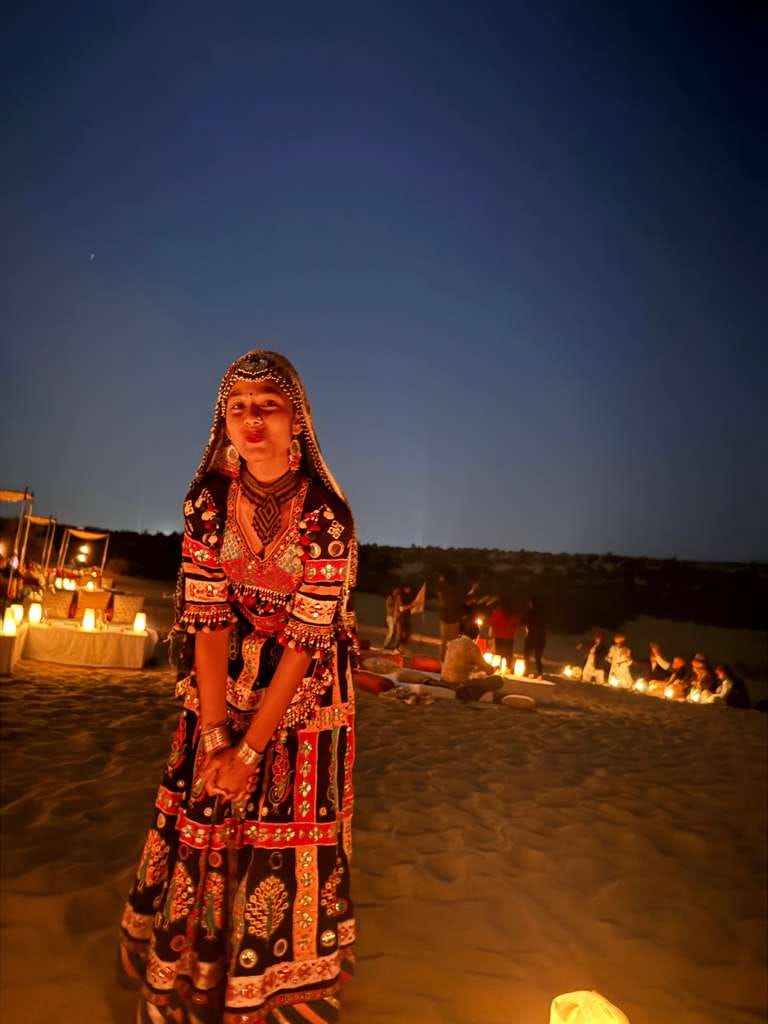
This is why Suryagarh has been so inspiring to experience. This property is itself an ark, preserving sacred knowledge systems through everything: the traditional craftsmanship in every hand-carved stone, the ancient Rajasthani recipes that honor farm‑to‑table desert ingredients, the fully initiated yoga masters, the traditional healing methods in the spa.
Suryagarh is Manu’s ark standing before modernity’s immediate flood. It accepts that forms change—the hotel is not a museum frozen in time but a living practice. It trusts that by maintaining conscious relationship with tradition, something essential—call it cultural DNA, call it dharma, call it consciousness—remains intact even as the external world transforms.
The property sits in Rajasthan, in the Thar Desert, one of the driest regions on earth. The entire culture here evolved around water scarcity, extreme heat, and sandstorms. That is desert dharma: a body of lived wisdom around how to move, eat, store, celebrate, and rest in a harsh but holy landscape.
When that knowledge is replaced by air‑conditioned glass hotels with limitless water on tap, we lose precisely the wisdom the future will demand.
Cultural preservation is not passive nostalgia. It is the active maintenance of templates for how to live rightly in a specific place, with specific resources, in relationship with specific land. When you sleep in a room built with ancient proportions, eat food prepared according to traditional principles, and move through spaces designed for particular states of consciousness—you are downloading cultural DNA through your body.
This is how the ark works: through immersion, not observation. You are not merely a tourist; you are receiving a transmission of a way of being.
The Paradox of Jaisalmer
Here is what makes this story even more profound: Jaisalmer itself was created by cultural mixing. It is not some “pure” indigenous culture, but a synthesis culture, born from the Silk Road’s long, slow cosmopolitan exchange.
Founded in 1156 CE, Jaisalmer was a strategic node on ancient trade routes connecting the Indian Ocean to Central Asia, India to Persia to Arabia to the Mediterranean. Through this golden city flowed silk and spices, horses and precious stones—and with them Persian architectural influences, Central Asian building techniques, Islamic geometric patterns meeting Hindu temple ornamentation.
Jaisalmer’s golden havelis were not built by cultural isolationists. They were built by Jain merchants who grew wealthy on Silk Road trade—men who spoke multiple languages, appreciated Persian poetry, and commissioned architecture that blended influences from three continents.
What Suryagarh preserves is not some mythical “pure” Rajasthani culture that never existed. It preserves the capacity for cultures to meet, blend, and create something beautiful while maintaining their distinctiveness. The Silk Road showed that it is possible: exchange without erasure, cosmopolitanism without homogenization, trade without cultural annihilation. Cultures met slowly, as relative equals, and created fusion while remaining themselves.
What made the Silk Road different from modern globalization? On the Silk Road, cultures met as trading partners, not as colonizer and colonized. Each brought something valuable that the other genuinely desired.
Ideas flowed in multiple directions: Persia influenced India; India influenced Persia. And crucially, the exchange happened at human speed. Caravans took months to cross the desert, which allowed time for discernment, digestion, and integration.
Modernity’s flood does not arrive by camel caravan. It arrives through fiber‑optic cable at the speed of light. Instagram can export a Los Angeles café aesthetic to every corner of the earth in seconds. Western—mainly American—culture becomes the default setting, and other cultures are recoded as “exotic.”
The flood is not evil. Connection is holy. But the speed and asymmetry can drown local culture before it has time to respond creatively. Change now moves faster than cultures can metabolize. One generation is enough to sever living connection to ancestral ways. There is no time for synthesis, only for submission or extinction.
You can have Starbucks in Jaisalmer, but you will not find chai wallahs on every corner in American towns. Local architecture is replaced by anonymous glass boxes. Regional cuisines are pushed to the margins by fast‑food chains. Traditional crafts disappear because mass production is “cheaper.” Languages—carriers of entire worlds—vanish; UNESCO estimates that roughly one language dies every two weeks, and around 40% of the world’s languages are currently at risk.
The hotel owner at Suryagarh is not curating a museum. He is tending a living ecosystem—the difference between taxidermy and a thriving forest. This is his gift to the world: a template, a proof of concept. Evidence that it is still possible to honor tradition while serving modernity, to preserve culture while remaining economically viable, to maintain distinctiveness while welcoming outsiders.
Like Noah, he has spent years building while others rushed past. Like Manu, he seems to understand that what must be saved is not just physical forms but the knowledge and consciousness encoded within them. Like Nuh, he chooses faith over blood—creating family not merely through lineage but through shared commitment to preservation and experiences that will be remembered for a lifetime.
Every generation faces a flood. Ours looks like endless scroll, mass migration, and disappearing ways of being. Every generation must ask: What are we putting in our ark?
When culture is not preserved, people still survive, but they do so cut off from context and origin. The result is a quiet, chronic grief that is easy to misdiagnose as anxiety or meaninglessness.
After forty days (which, not coincidentally, is also the time many say it takes to break a habit), Noah’s ark found land and released the animals to repopulate the earth. The hope woven into these ancient stories is that arks are not endpoints but seed banks. When the flood of homogenization recedes—or when enough people wake up to what has been lost—places like Suryagarh can help regenerate regional consciousness and diversity by planting the seeds of what was kept sacred.
Perhaps Suryagarh is preserving all three of the dimensions the flood stories ask us to protect: the sacred relationship with this specific ecosystem (creation), the community committed to preservation (faith), and the knowledge embedded in every carved stone and traditional recipe (dharma).
The Silk Road suggests it is possible. Jaisalmer proves it has already happened. Whether it can happen again depends on how many arks survive the flood—and how many of us choose to board them not as tourists seeking entertainment, but as students willing to receive transmission.
The man who built Suryagarh is offering more than a place to stay. He is offering a way of seeing, a way of being, a remembrance of what humans can create when we move slowly enough to honor place, when we meet as equals rather than conquerors, when we understand that preservation is not resistance to change but protection of our capacity to change consciously.
This is the work of the noble patriarch I saw in those men at the retreat: stewardship of what must not be lost. This is the communion of peace between tribes: preservation not of purity, but of possibility.
The flood is here. The question is not whether we will lose much—we will. The real questions are: What are we choosing to save? And are we brave enough to board the arks others have built, even when the world calls them backward, inefficient, impractical?
Because after the flood, these seeds become everything.
Human. Being.
Both. Always both.
In Everything We Trust,
Sylvia