


The best advice I ever received arrived in a single sentence: before you commit to someone, travel with them.
It sounds simple. It isn't.
It's quietly revolutionary — because travel strips away the performance. The familiar scaffolding falls, and what's left is the actual person. You see how they meet a canceled flight, a wrong turn, a language they don't speak. You see who they are when they have to tip a stranger, share a difficult meal, or sit inside genuine uncertainty. You see, in other words, everything.
I have been an insatiable traveler my entire life. Travel is not something I do — it is something I am made of.
I've spent months at a time rooted to a single place, like the period I lived in the shadow of Mount Arunachala in southern India, where the sage Ramana Maharshi spent nearly his entire adult life. As a young man, Maharshi experienced a spontaneous awakening so total, so consuming, that it pulled him from everything he had ever known and deposited him at the foot of that mountain — where he essentially remained until he died. A devoted lover of one sacred coordinate on earth.
From him, I learned something I haven't forgotten: that fidelity to place is its own kind of wisdom. That stillness can be as expansive as motion.
And then I've traveled in ways that would unsettle most people: alone, unplanned, and largely broke — hitchhiking in the beds of trucks through Central America, sleeping in hammock huts rented for pennies, eating iguana soup because it was Tuesday and that's what there was. I've woken to first light in cold wilderness with nothing but wind for company, and I've woken in crisp white hotel beds with blackout shades and coffee delivered by a white-gloved hand.
After all of that, the outer conditions no longer move me. What moves me now is the question underneath: who do I become here?
We travel not to collect impressive stories. We travel to be changed — to be humbled, disoriented, and cracked open just enough for wonder to get in. To remember that we are not in control of very much at all, that this world was not designed to please us, and that this is, somehow, the best news imaginable.
We travel to remember that the world is a gift. Not a resource to extract from. Not a backdrop for content (please for the love of god stop with the selfies everywhere). A holy, living, playful gift that keeps offering itself — endlessly patient — to anyone willing to receive it.
This past week, I received that all over again.
I took my younger son — just the two of us — on his first mother-son trip, boating through the Greek islands. He is fourteen. He has inherited my love of adventure, but in a form that exceeds mine: he appears to have zero fear of anything. Watching him move through the world, I could feel something ancient and biological at work — that particular wiring in young men that has always called them toward edges, toward horizons, toward the next unknown. His nervous system is hungry. It was beautiful and, at moments, genuinely terrifying.
In Corfu, we rented a small car and set off for Paradise Beach. We had a map, a route, the comfortable modern fiction of digital certainty. But midway there, my son spotted a sign for a golf course — he's learning the game — and lit up the way only fourteen-year-olds can. So we turned off the road to paradise and stepped into a different one.
The course was overgrown, half-wild, gorgeous in its imperfection — as though the land had decided to gently reclaim the game for itself. We played nine holes, well he played them and I mostly just enjoyed the nature.
After that, we needed to remap our route from a new starting point. Google showed us two roads to Paradise Beach — which is, if you let it be, a perfect metaphor — and we chose the one that cut through what looked like a more natural landscape.
For the first ten minutes: lovely. Forested, dappled, the small thrill of intuition aligning with the GPS. Then the road turned to dirt.
I am not afraid of a dirt road. Dirt roads have featured in many chapters of my life. But this one was narrow — a single lane, no room to turn around, clearly not traveled by anyone in recent memory. Our very confident digital map had delivered us onto what was essentially a trail. We had forty-five minutes of a road that was impossible to turn off of, or to turn around.
And so for forty-five minutes, we were shaped by travel.
I thought of when my sons were younger, crossing rivers in a car in Costa Rica — the way I would assess the current and commit to the crossing with calm in my body, even when doubt murmured quietly in my chest. I had learned that children don't watch what you say in those moments; they watch what your body does. My body remembered that woman. She showed up again in Corfu, hands on the wheel, moving forward.
We stopped many times — simply to honor where we were. To open the doors, let the air in, listen. To actually see the landscape we were threading through, rather than merely surviving it.
The best moment came without warning.
We drove into a butterfly forest.
The air suddenly filled — filled — with tiny yellow and white butterflies, rising like confetti shaken from the hands of the afternoon. They swirled around the car as if we had crossed into a different dimension. We stopped. Stepped out. Extended our hands. And the butterflies landed on us, weightless and unhurried, dancing with the sunlight and each other and us.
For a few minutes, time didn't just slow — it stopped. It felt like Arunachala again. A place that asks you to be fully present. A portal that rewires you, if you have the sense to step through it.
Eventually, the trail deposited us — without ceremony — into the back of a very old village. Wild forest became cobblestone. Ancient cobblestone, barely wide enough for our car, winding in ways that suggested the roads had been drawn by someone who had never considered a vehicle.
No cell signal. Every sign in Greek. Villagers moving through their day, entirely unbothered by our existence.
I drove the way you learn to in moments like that: slowly, precisely, reading the architecture like a second language but really could not figure out how to get out of the village. At one point, I turned down a lane that was simply impossible and heard a woman's voice pouring down from an open window above — rapid, certain Greek that needed no translation. This is not the way.
She was right.
I called back — I don't speak Greek! — and she came down. Then three more women came down. Four strangers gathered to help me reverse my car out of their village, inch by careful inch, through streets they knew by heart. They owed me nothing. They gave me everything.
There is a lesson tucked inside that moment, and I want you to receive it: people are kind. Not theoretically. Actually. You can count on human kindness — from strangers, across languages, across cultures. Keep your heart open to the human.
When we finally reached the main road at the front of the village, there was a sign in English: Very narrow roads — do not enter with cars.
Of course, there was no such sign at the back of the village, where we had blundered in.
Of course.
From there, we found Paradise. We were hungry, thirsty, sun-warmed, and loose with the particular joy of people who have earned their lunch. A young waiter at a tiny taverna took one look at us and made our joy his personal mission. He waved away the menus — just eat what I bring you — and brought us kolohtipa cooked in buttery tomato sauce with heaps of fresh pasta, and cold cucumbers dragged through tzatziki. The sea was turquoise. The air was soft. My son was glowing.
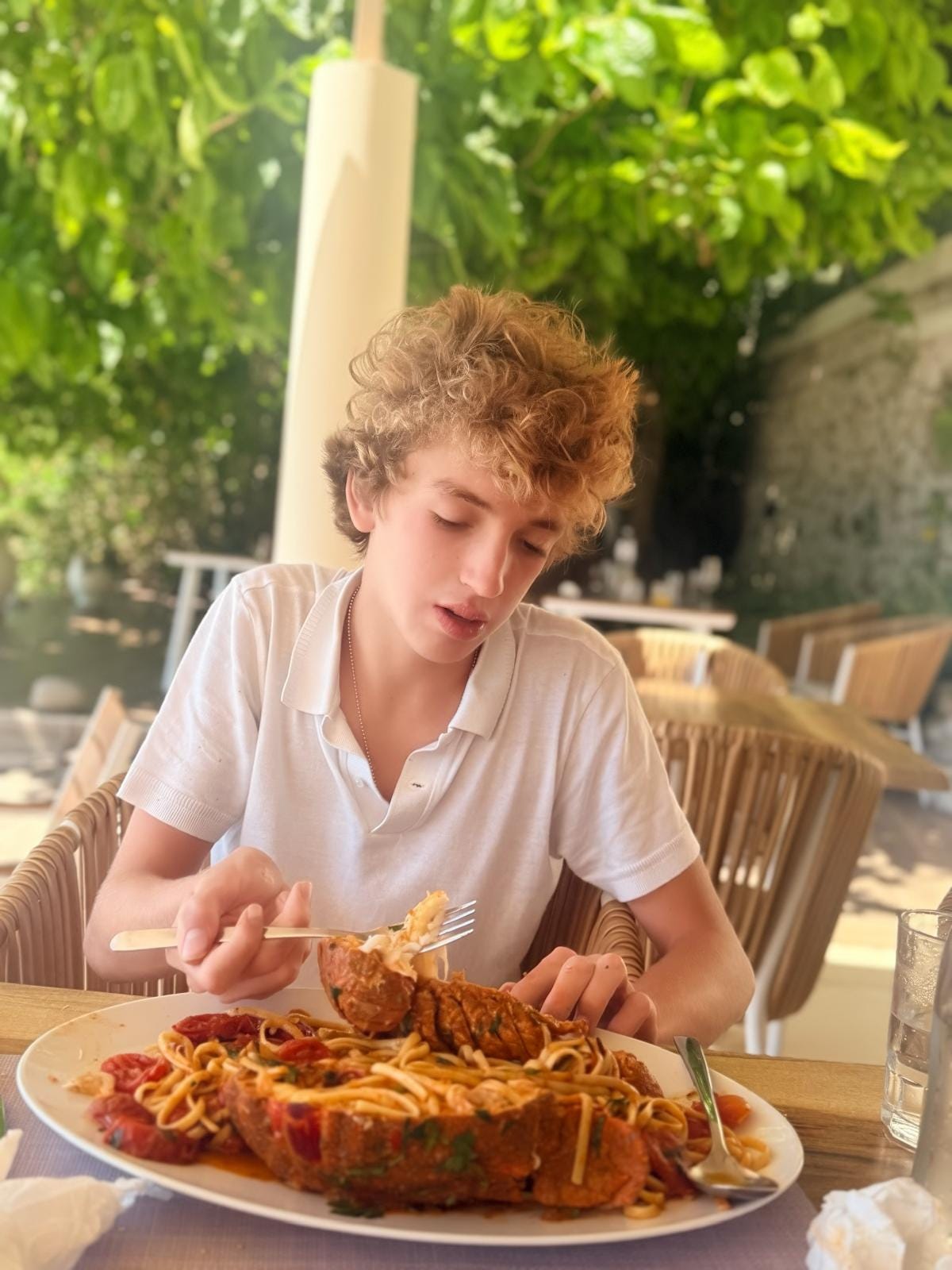
He will carry that day with him for the rest of his life. I am certain of it. Not because it was perfect — because it was real. Because the wrong turns were part of it. Because the butterflies were part of it. Because the women who helped us were part of it.
As summer begins, I want to offer you this:
Travel is not about luxury or its absence. It is about presence.
Some people prefer comfort and predictability on the road — that is entirely fine. What matters is not the thread count of your sheets but the quality of your attention. Treat everyone you meet with love, because when you travel you are an ambassador — of your culture, your values, your way of moving through the world. And receive their ways with equal love. The more we respect each other's cultures, the less war there is. I believe this completely.
Let your travel this summer be your peace treaty.
Let it teach you and form you and return you changed — not because you want impressive stories to tell, but because you want to know what you're made of when the flight is delayed, the map is wrong, and the road turns to dirt.
In an age of AI and algorithmic everything, when shopping centers and Starbucks are slowly steamrolling what remains of the particular, the local, the irreplaceable — it matters more than ever to taste what this planet still offers. Not to photograph it. To taste it.
Love the road. Love the people. Love the butterflies and the stone villages and the women who come downstairs for strangers.
Love even the wrong turns — especially those. They are often the only way to find the butterfly forests.
Let your travel be your prayer. A living reminder that this world, against extraordinary odds, is still a gift.
And with that, I leave you, as I have some more days with my son, who is sleeping by my side as I write this in the early morning. More days to keep tasting, to keep teaching him how to travel and for him to teach me again, how to be wild.
What would someone learn about you if they traveled with you? That is the question worth sitting with this season.
In Everything We Trust,
Sylvia
goodness; felt like I was on the journey too.
Wow how incredibly beautiful I feel this so deeply. 🫶🏼❤️